Office Furniture Planning
A Practical Guide to Choosing Hardwood File Storage
Paper may no longer dominate the office, but the records that remain still need a sensible home. Choosing the right hardwood file storage starts with a few practical questions: what sizes do you keep, how often do you retrieve them, and how much room can you spare?
For Hudson Valley businesses, nonprofits, schools, and home offices, those answers matter more than a cabinet’s appearance alone. A vertical file cabinet, a lateral cabinet, and a file credenza can all organize documents; they do it in different ways. Drawer orientation, capacity, clearances, construction, and the mix of active and archived records determine which option will work day after day.
Begin with the documents, not the furniture
A storage decision is easiest when it begins with an inventory. Identify the records that must remain in paper form, the formats they use, and who needs access. Letter-size and legal-size files are common, but a cabinet designed for one arrangement may not automatically accommodate the other. Check the actual filing configuration before making assumptions based on drawer dimensions or a product name.
Next, distinguish working files from records kept for reference. Current contracts, personnel folders, invoices, and project documents may be opened repeatedly. Older records might be retained for policy, operational, or legal reasons but consulted infrequently. The first group needs convenient access near the work area; the second may be better placed in a less prominent location, subject to your organization’s retention, security, and access requirements.
Estimate the volume of each group. Count drawers or boxes rather than relying on a vague sense that the office has “a lot” of paper. Note whether folders are already crowded, whether they need room to expand, and whether additional records are expected. A useful plan leaves some spare capacity. Filling every drawer on day one can make filing slower and turn a new cabinet into a short-lived solution.
- List the document sizes and filing formats in use.
- Separate frequently used files from records accessed occasionally.
- Estimate present volume and likely additions over the next few years.
- Identify who needs access and whether any records require restricted storage.
Vertical or lateral: a question of footprint and workflow
Vertical file cabinets arrange documents in drawers that extend outward from a relatively narrow footprint. In many setups, folders are filed front to back. The format can make sense where wall width is limited and a compact cabinet is useful. It may suit an individual workstation or a small office that needs a defined place for active files without spreading storage across a long wall.
The trade-off is depth and drawer reach. A vertical cabinet often projects farther into a room when open, so the space in front of it matters as much as the space it occupies when closed. If a cabinet sits beside a desk, in a corridor, or near a doorway, an open drawer can interrupt circulation. Before choosing this arrangement, consider whether someone can stand comfortably at the cabinet while other people move through the area.
Lateral file cabinets are wider, with files commonly arranged side to side. Depending on the cabinet and configuration, they may hold letter-size or legal-size documents in a horizontal drawer. Their broad top can sometimes serve as a surface, but that should not be treated as a substitute for a planned worktop without checking the piece’s intended use. A lateral cabinet can make a large volume of records easy to scan, yet it needs more wall width and may be less suitable where every inch of frontage is already committed.
Neither type wins by default. Compare the usable storage capacity, the filing arrangement, and the room’s geometry. A narrow room with a clear aisle may accommodate a vertical cabinet well; a wider office with a long wall may make lateral storage more practical. The right answer is the one that fits the work pattern and leaves everyday movement uncomplicated.
Filing orientation is an everyday detail
Orientation can sound like a technical distinction until someone needs a specific folder in a hurry. Letter-size files may be arranged front to back or, in some lateral configurations, across the drawer. Legal-size files can require a different orientation. A cabinet may support more than one format, but the required bars, clips, or other filing hardware should be confirmed rather than presumed.
Check how many rows fit in each drawer and whether rows move independently. In some designs, two rows share a drawer without separate movement. That can affect how users reach the back row and how files are divided. Consider the labels your team uses, the frequency of retrieval, and whether a consistent sequence can be maintained across departments.
Make a simple test plan before purchase: choose a representative folder, note its dimensions, and verify the drawer’s usable interior and hardware arrangement. If the office stores both letter- and legal-size records, map where each will go. This small step can prevent the common mismatch in which the cabinet fits the room but the intended folders do not sit as expected.
Credenzas and integrated storage
A file credenza combines document drawers with a low, wider furniture form. It can be useful in a private office, meeting area, or shared workspace where storage needs to feel integrated rather than purely utilitarian. Depending on its design, a credenza may include file drawers alongside accessory drawers or cupboards, giving different office items separate places.
That versatility requires careful planning. Confirm which drawers are intended for files, what formats they accept, and how many folders they accommodate. General-purpose storage should not be counted as filing capacity unless the interior is suited to the records involved. A credenza’s wider profile also means it needs an appropriate wall run and a clear path for opening drawers.
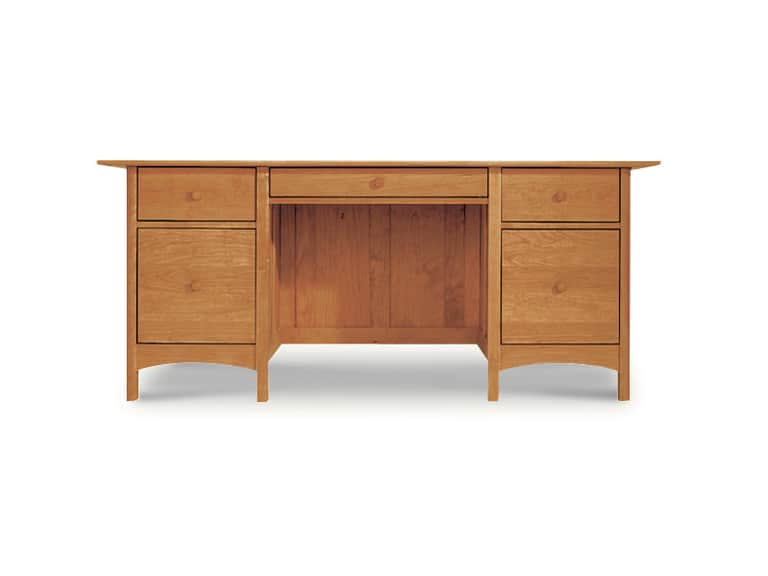
Other furniture can sometimes reduce the need for a separate cabinet. A desk with built-in file storage keeps frequently consulted materials close to the person doing the work. For example, the [Heartwood Shaker Executive Desk](/products/heartwood-shaker-executive-desk-4401) includes two accessory drawers and two file drawers and is described as accommodating letter- and legal-size documents with included filing bars and clips. Its format may be relevant when integrated storage is useful, though the amount of filing space should be compared with the office’s actual volume.
What hardwood construction changes
Hardwood storage introduces a different set of considerations from a standard metal cabinet. Material, joinery, finish, drawer construction, and intended use all shape the experience. A solid-wood cabinet can bring warmth and a crafted presence to a workspace, particularly where furniture is visible to visitors or forms part of a home office. The decision should still be grounded in capacity, stability, dimensions, and care—not the material alone.
Vermont Furniture Designs’ range of hardwood office furniture includes file cabinets, file credenzas, and desks with filing drawers, with descriptions emphasizing solid hardwood construction and natural oil finishes on many pieces. Some items are handcrafted to order in Vermont. Those details may help an organization compare construction and finish choices, but they do not replace checking the specific cabinet’s dimensions, filing hardware, lead time, and configuration.
Wood finishes are part of long-term ownership. A natural oil finish protects and enhances the appearance of the wood; maintenance requirements depend on the particular finish and care instructions. Ask how to clean the surface, what to avoid, and whether routine care differs from that of a laminate or painted metal cabinet. In a busy office, the best finish is one staff can maintain consistently.
Hardwood furniture can be substantial. Before installation, check the floor’s condition and the route from delivery point to final location, including doorways, stair turns, lifts, and tight corridors. Confirm the assembled dimensions and whether the piece arrives assembled. A cabinet that fits its final wall may still be difficult to move there.
Measure the room—and the open drawer
Floor plans often show furniture in its closed position. File storage demands more: a drawer must open, a person must reach inside, and the route around it should remain usable. Measure the cabinet’s width, depth, and height, then account for the full extension of its drawers. Check nearby desks, chairs, doors, radiators, windows, and other obstacles.
In a shared office, clearance is a circulation issue as well as a convenience. A cabinet that blocks an aisle when open can create repeated friction for staff. Place high-use files where people can reach them without crossing the busiest path. If several employees need access at once, consider whether one larger cabinet or multiple smaller units will create the smoother arrangement.
Also consider what sits above or beside the cabinet. A display, printer, or supply area may seem efficient, but items placed on a storage surface can obstruct access or add clutter. Keep frequently used supplies within reach while preserving a clear area for sorting and returning folders.
Plan for safe, reliable use
Filing cabinets are heavy, especially when fully loaded. Follow the manufacturer’s guidance on installation, loading, and anchoring. Avoid opening multiple drawers at once unless the unit is designed to permit it. Load drawers evenly and do not exceed stated limits. These precautions matter in any office, and particularly where cabinets are used by the public, children, or staff unfamiliar with the furniture.
Security is a separate question from construction. If files contain sensitive information, determine whether the cabinet provides a lock and whether that level of protection meets organizational policy. A lockable drawer is not a complete records-management system: access procedures, key control, retention schedules, and secure disposal still matter. For digital and paper records alike, assign responsibility for keeping information appropriately controlled.
Accessibility deserves attention, too. Consider the reach and strength required to use drawers, the location of handles, and the force needed to open a loaded unit. Frequently used files should not be placed where access is difficult for a staff member who needs them. When planning a shared workplace, include the people who will use the storage in the evaluation.
Budget for the full decision
The purchase price is only one part of the cost. Include delivery, installation, hardware, any required floor protection, and the time involved in reorganizing records. For made-to-order furniture, confirm the expected production timeline before building it into an office move or renovation schedule. Ask about warranty coverage and service arrangements, and keep product documentation available for future maintenance.
Compare the cost of a cabinet with the value of usable capacity. A lower-priced unit that cannot accommodate the required filing format, or that forces the office to add another piece immediately, may not be the economical choice. Conversely, a large hardwood unit may be unnecessary for a small archive or a workspace shifting toward digital records. Match investment to real use, not to a hoped-for image of the office.
For public agencies, schools, and nonprofit organizations, procurement may involve multiple approvals or requirements. Document the criteria before comparing options: dimensions, filing format, capacity, finish, lead time, security, accessibility, and total delivered cost. A consistent checklist makes the choice easier to explain and reduces the risk that a visually appealing detail outweighs a practical need.
A simple comparison checklist
Use this checklist when reviewing vertical file cabinets, lateral cabinets, credenzas, or desks with integrated file storage:
- Documents: Which sizes and formats must the furniture accommodate?
- Volume: How many active and archived files need a home, with room for reasonable growth?
- Access: Who retrieves files, how often, and from which side of the room?
- Orientation: How are files arranged, and what hardware is included?
- Footprint: Do the closed unit and fully open drawers fit without blocking circulation?
- Construction: What materials, joinery, finish, and care instructions apply to the specific piece?
- Safety and security: Are loading guidance, anchoring needs, and access controls understood?
- Logistics: Are delivery route, installation, production time, and total cost accounted for?
A better fit begins with a clear brief
Choosing hardwood file storage is less about finding a universally best cabinet than about making the arrangement fit the records and the room. Vertical cabinets can make good use of limited wall width; lateral cabinets offer a broad filing layout; credenzas bring filing into a wider furniture form; and a desk with file drawers can keep working documents close at hand. Each option should be judged by its actual filing configuration, capacity, dimensions, and use.
For a Hudson Valley office, the practical sequence is straightforward: inventory the paper, measure the room, map the drawer clearance, confirm file formats, and compare construction and care requirements. Then consider how the piece will look in the workspace. A well-chosen cabinet should make records easier to retrieve and return, occupy its space without disrupting movement, and remain useful as the organization’s needs change.
That is the quiet promise of good office furniture planning. Storage does not need to dominate a room or become a recurring problem. When its details are considered before the purchase, it can support the ordinary work that keeps an organization moving.